
Bitcoin, USDT, Solana and Litecoin for Casino Payments: A Practical Comparison
Compare payment compatibility, asset exposure, network costs and custody without confusing blockchain speed with an operator's withdrawal approval time.
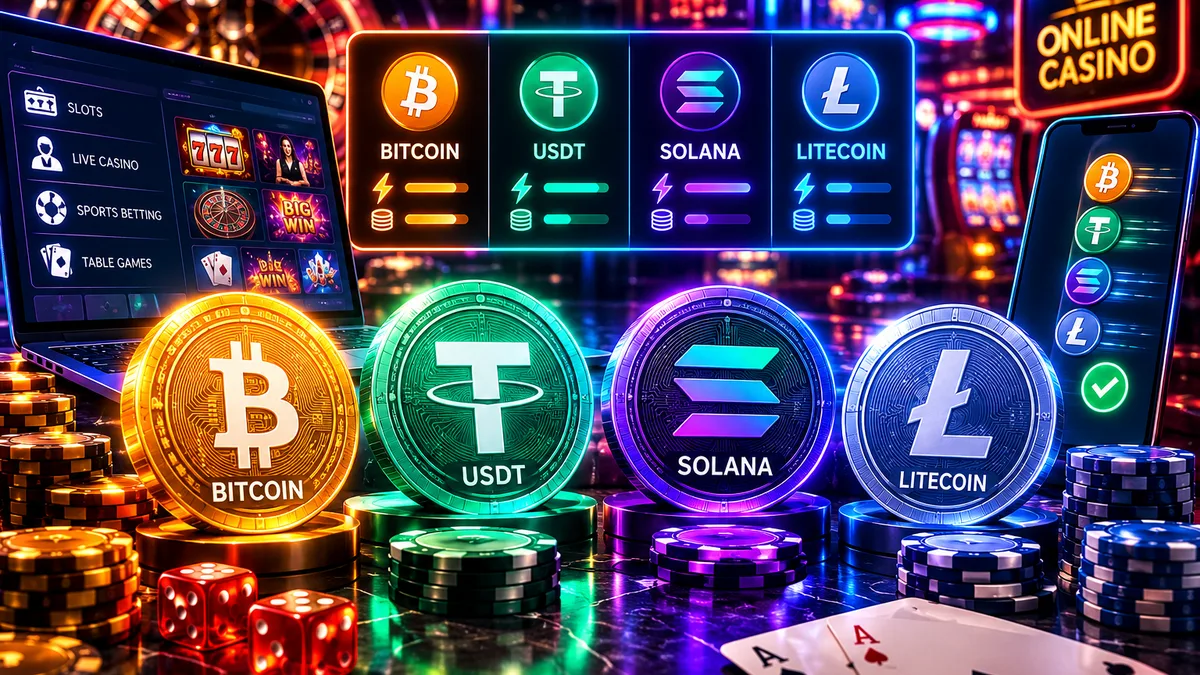
There is no single best cryptocurrency for every casino payment. The useful comparison depends on what the recipient supports, how the account records value, the costs of moving the asset and who controls the funds after a deposit. A fast network does not make an operator approve a withdrawal quickly.
Bitcoin, USDT, Solana and Litecoin should therefore be compared as payment routes, not ranked using unverified claims about minute counts or fixed fees. Begin with the operator's current cashier instructions and the sending service's current withdrawal screen.
Asset value and account value are different questions
Check whether the gambling account keeps a cryptocurrency balance or converts the deposit to a fiat-denominated balance. That choice changes which value is exposed to an asset-price movement while the money is held in the account.
For a purely hypothetical illustration, 0.01 units of an asset priced at €20,000 are worth €200. If the same units are later priced at €18,000, they are worth €180. The €20 change is separate from any gambling result. These are invented prices used for arithmetic, not market quotations.
USDT is a different proposition. Tether explains its token model, which is designed around a corresponding fiat value. Do not treat that design as a guarantee that every intermediary will buy your tokens at precisely the reference value without charges. Check the actual conversion or redemption route you can use.
Network support comes before theoretical speed
Bitcoin and Litecoin are different assets and networks. SOL is the native asset used for Solana transaction fees. USDT can be issued on multiple supported protocols. A cashier label saying “crypto accepted” does not establish support for all of them.
Tether's protocol list includes token identifiers and distinguishes supported and deprecated protocols. The sender and recipient must agree on the particular route. A correct token symbol with an unsupported network can still fail the recipient's deposit requirements.
Do not copy instructions from a previous transaction without checking them again. Confirm the asset, network, recipient details and any minimum deposit. If a memo or other extra identifier is requested, determine what the recipient requires before sending.
Add every cost layer
Network fees, sending-service withdrawal charges, exchange spreads and operator charges are different costs. A low network fee does not establish a cheap complete payment. For a hypothetical transfer with a €1 network fee, €2 service charge and €1 conversion cost, the total is €4.
Solana's documentation states that transaction fees are paid in SOL. Bitcoin's documentation explains that fee conditions can affect confirmation. Neither source promises a particular casino's total cost. Obtain the actual quote from each service involved.
Separate broadcasting, confirming and crediting
An operator first has to send a payment. A transaction then has to be processed by the relevant network, and the recipient may wait for its own acceptance conditions. These steps should not be collapsed into one “payout speed”.
Bitcoin's payment-processing guide explains confirmations as evidence against double-spending risk. It does not set a casino withdrawal deadline. Request the transaction reference when a withdrawal is said to have been sent, and investigate the relevant stage rather than assuming the network caused every delay.
Custody determines what you can control
A self-managed wallet and a balance at an intermediary involve different control arrangements. Bitcoin's wallet-selection material describes control and security considerations. Once funds have been transferred to an operator-controlled account, your original wallet cannot make that operator release them.
Read the recipient's custody and withdrawal terms. A payment route can work perfectly while the service holding the resulting balance creates a separate problem. Do not evaluate the deposit network and ignore the organisation receiving the money.
A practical comparison sheet
For each supported option, record the exact asset and network, how the casino denominates the balance, the sending and receiving fees, minimums, confirmation policy and available withdrawal route. Include the steps needed to convert withdrawn funds into the currency you actually use.
Leave an item unresolved when the information is unavailable. Litecoin should not receive an invented speed or fee advantage merely to complete a comparison table. A defensible choice rests on the supported route and current documented costs, not on a universal claim that one coin is always cheapest or safest.
Related Guides
💬 Community
Join our official Telegram community:https://t.me/casinorank_fun
About the CasinoRank.fun Editorial Team
Articles are informational. Check cited sources, applicable terms and update dates.