
How to Set a Gambling Budget: Spending Limits, Session Plans and Warning Signs
A practical framework for separating gambling from essential spending, setting limits before play and recognising when a budget is no longer enough.
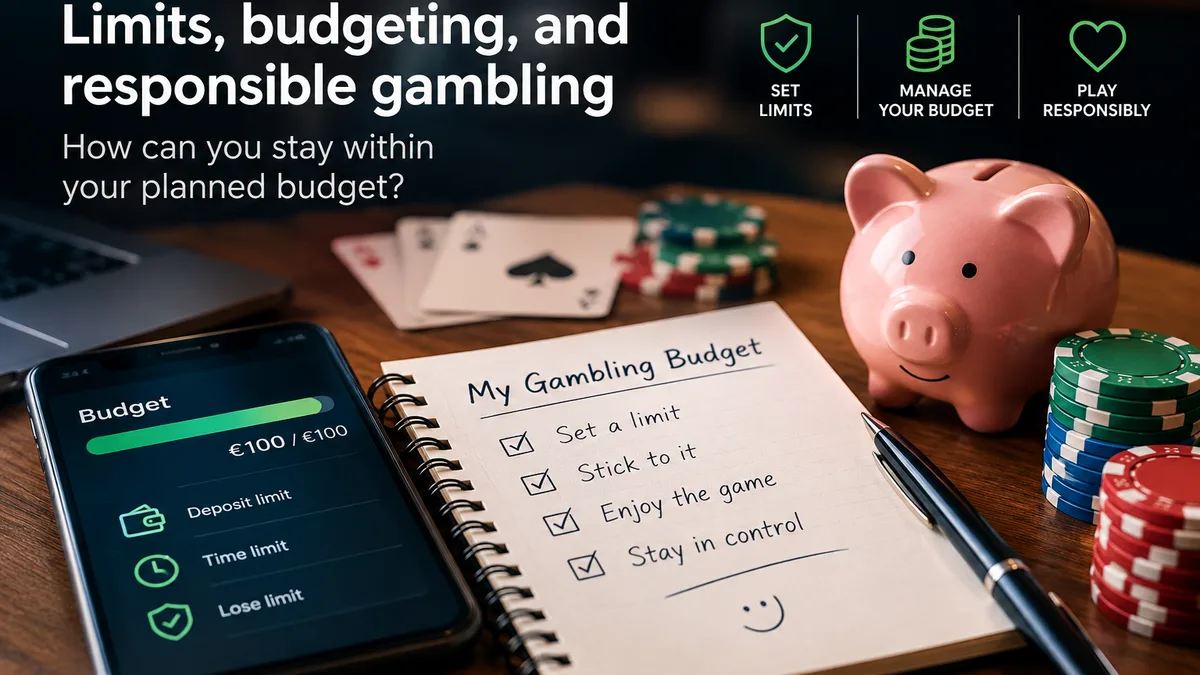
A gambling budget is a spending boundary, not a system for generating income. Its purpose is to prevent an optional activity from consuming money needed elsewhere. The useful question is not how much you hope to win, but how much you could lose without changing your ability to pay bills, save or meet existing commitments.
GamCare's money guidance treats essential expenses and financial control as priorities. The framework below is an illustrative planning method, not a recommended amount for every household.
Start with money that already has a job
List housing, food, utilities, transport, debt repayments and other unavoidable commitments before allocating anything to entertainment. Include irregular costs: an annual insurance bill still needs funding even when it is not due this month. Keep an emergency reserve separate. Money available on a credit card is borrowing capacity, not disposable income.
If these commitments leave no comfortable surplus, the appropriate gambling budget is zero. A promotion does not change that calculation. Neither does a previous win: money withdrawn from gambling can pay real expenses and should not automatically become another session's bankroll.
Choose a loss ceiling rather than a deposit target
Suppose, purely as an example, someone allocates €40 to optional entertainment for a month. They might reserve €10 for gambling and €30 for other activities. The €10 is the maximum acceptable loss, not an instruction to spend it. If the person has already lost €10, a new payday or a cashback message does not reset that month's boundary.
Deposits and losses measure different things. A player who deposits €20 and withdraws €15 has a €5 net cash loss, assuming no other transfers. Yet repeated deposits can hide the scale of spending. Track deposits, withdrawals and the balance remaining separately. Do not count a pending withdrawal as money already received.
Translate the monthly boundary into a session plan
Write down the session's maximum spend and finishing time before opening a game. Keep the unused monthly allocation outside the gambling account. This creates a clear distinction between a session ending and a decision to make another deposit.
Stake size changes how quickly the spending limit can be reached. Twenty losing €0.50 bets consume €10; twenty losing €2 bets consume €40. That arithmetic does not predict a particular session, but it shows why a higher stake is not a solution to a smaller budget. Splits, doubles and side bets can increase the total amount committed beyond the displayed main stake.
Use controls that match the problem
A deposit limit restricts money entering an account. A loss limit addresses a different measure, while a session reminder mainly makes elapsed time visible. Read the operator's definitions: whether a limit is gross or net, when it resets and whether withdrawals affect it can change its practical effect.
Bank gambling blocks, cooling-off tools and self-exclusion may provide additional barriers. They are not interchangeable and availability differs by location. Choose controls before a stressful session, rather than relying on a promise made after a loss. Record the settings and check that they are active.
Recognise when budgeting is no longer sufficient
Repeatedly raising limits, borrowing, concealing spending or treating the next bet as a way to repair the previous loss are reasons to stop and seek support. A spreadsheet cannot make harmful gambling affordable. Do not turn a spending review into a calculation of how much must be won back.
Review records away from the game. Look at the monthly net transfers and the time spent, not just the biggest win. If the activity no longer fits comfortably within the plan, remove it from the budget. There is no requirement to use the allowance simply because it exists.
A short checklist before playing
Confirm that essential costs and reserves are funded, the money is not borrowed, and the loss ceiling and finishing time are written down. Check whether the game can create additional bets beyond the initial stake. Finally, decide what you will do when the session ends: close the account screen and return to the planned activity, without making a replacement deposit.
The most effective budget is one that remains meaningful after a disappointing result. If a limit becomes negotiable whenever you lose, it is no longer serving its purpose.
Related Guides
💬 Community
Join our official Telegram community:https://t.me/casinorank_fun
About the CasinoRank.fun Editorial Team
Articles are informational. Check cited sources, applicable terms and update dates.